10 Things a First-Time Corporate Conference Planner Must Know

Hello, this is Chris & Partners! 😊
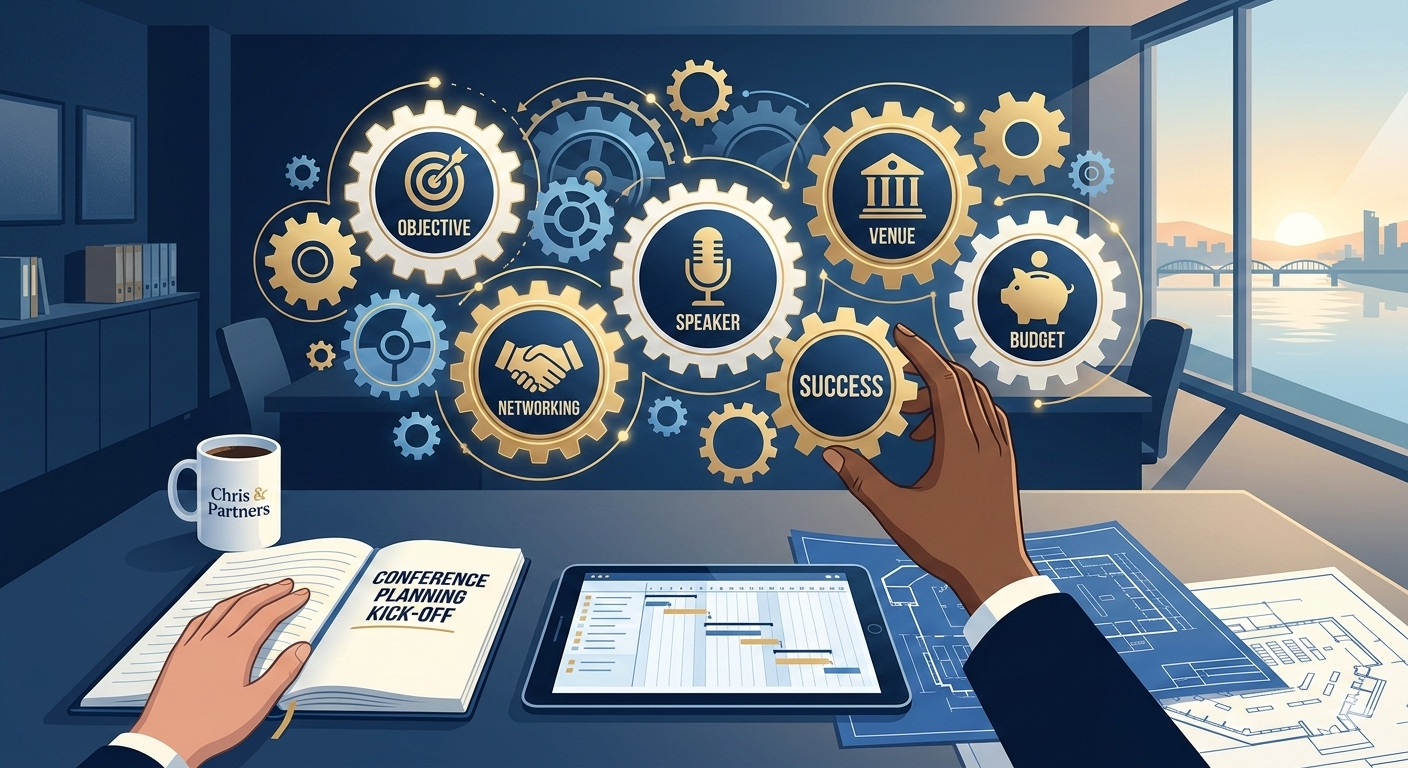
Ever suddenly found yourself the conference lead? It feels daunting at first, but once you know the key order, the path appears. Today, we've organized the 10 must-knows for planning a corporate conference, in priority order.
1. Define the event's purpose and goals first
The starting point of all planning. If the purpose is unclear, every later decision wavers.
• Decide the type first—information-sharing / networking / branding
• Set measurable KPIs (e.g., 200 participants, 10 press mentions)
💡 Pre-agreement with executives and department heads is essential—a direction set by the lead alone is easily overturned.
2. Build the budget by item and always secure a contingency
Per MPI guidelines, set 10–15% of the total budget as contingency.
• Venue rental (20–30% of total) · F&B · speaker fees · AV equipment
• Account for every item—printing, promotion, operations labor, contingency
💡 Build a budget sheet in Notion/Asana/Excel to track spending in real time.
3. Select a venue fitting the event scale right after confirming the purpose
The venue determines participants' first impression. Popular venues sell out months ahead.
• Check capacity (expected attendees ×120%), transit access, AV infrastructure
• Confirm whether catering can be brought in, and support facilities (lounges, breakout rooms)
💡 Always do a site inspection before signing.
4. Create a D-Day countdown schedule
Backward planning—setting the event day as D-Day and planning in reverse—is the industry standard.
• D-90 confirm purpose/budget → D-60 open promotion/registration → D-30 contract AV/catering
• D-7 distribute the operations manual → D-1 rehearsal → D-Day run the event
💡 Manage it in a shared Google Sheets/Notion doc so the whole team can check in real time.
5. Design the program flow first, then book speakers
Speakers first → fitting the program around them is a classic mistake.
• Design in order: opening → keynote → sessions 1·2·3 → networking/panel → closing
• 15–20 min breaks between sessions are a must / confirm speaker fees, copyright, and interpretation needs in advance
6. Build the participant registration system systematically
Manual Excel work causes duplicate and omission errors. Use a professional platform.
• A registration platform like Eventbrite → set up automatic confirmation emails
• Link QR-code check-in / grasp participant types (general·VIP·press) and dietary restrictions in advance
💡 Prepare a separate on-site registration process for VIPs and press even after the deadline.
7. Build a detailed plan for AV equipment and tech operation
The No. 1 on-site trouble is technical issues—audio feedback, screen errors, and the like.
• Confirm the stage-layout drawing, mic types/quantities, and laptop-connection method in advance
• Decide whether to livestream / meet the AV vendor at least twice in advance / rehearsal is a must
8. Plan promotion and participant communication along the schedule
Execute multiple channels sequentially along the timeline.
• D-90–60 Save the Date → D-60–45 distribute invitations and registration links
• D-14·D-3 reminders → day-before on-site guidance → thank-you email within 3 days after
💡 Build anticipation with countdown-style social posts and unify the hashtag.
9. Always prepare an operations manual and a Plan B
Variables—speaker cancellations, faulty equipment, bad weather—can arise anytime.
• Partner emergency contacts · a timed running order · a staff role-assignment table
• Document emergency scenarios (speaker absence·power outage·medical emergency) in advance
10. Post-event evaluation and follow-up are part of planning
Planning continues after the event ends. Follow-up is the foundation of the next event.
• Send a satisfaction survey within 24–48 hours after the event (10 questions or fewer)
• Share presentation materials/video · write a settlement report · document improvements

✅ The 10-step conference-planning checklist
Check off each item below as you go.
☐ 01.Set purpose/goals — confirm event type·KPIs, complete executive agreement
☐ 02.Build the budget — allocate by item, secure 10–15% contingency
☐ 03.Select the venue — complete site inspection, sign the contract
☐ 04.Create the schedule — make and share the D-Day countdown schedule
☐ 05.Speakers/program — design the program flow, book and contract speakers
☐ 06.Registration system — set up the platform, configure automatic confirmation emails
☐ 07.AV/tech operation — contract the AV vendor, confirm the rehearsal schedule
☐ 08.Promotion/communication — plan and execute channels and timeline
☐ 09.Operations manual — finish documenting the running order and emergency scenarios
☐ 10. Follow-up — organize the satisfaction survey, settlement report, and improvements
In closing
Walk through the 10 steps one by one, and even a first-time lead can surely create a great event. If corporate-conference planning feels burdensome or you need expert help, reach out to Chris & Partners anytime. 😊