The Concept of Blockchain and How It Differs from Traditional Financial Transactions

The Concept of Blockchain and How It Differs from Traditional Financial Transactions
Hello, this is Chris & Partners.😊 ‘Cryptocurrency’—what comes to mind first? Probably ‘blockchain,’ right! You've heard of it a lot, but since it's based on unfamiliar terms and specialized knowledge, many may not really understand it, so for those people, today we'll look at blockchain's basic concept and features. 🌐💰
What is blockchain?

Blockchain can be seen as a technology that stores data safely and keeps it intact. The dictionary definition is ‘a distributed data-storage technology that transparently records transaction histories in a digital ledger anyone can view and copies and stores it across multiple computers.’ That is, it refers to a technology where all users participating in the network distribute and store data such as all transaction histories. The name ‘blockchain’ comes from blocks tied together in chain form. In blockchain, a ‘block’ is a ledger where person-to-person (P2P) transaction data is recorded. After being formed, such blocks come to have a ‘chain’ structure connected sequentially over time. Since all users hold the transaction history, checking it requires cross-checking the ledgers all users hold. For this reason, blockchain is also called a ‘public ledger’or a ‘distributed ledger.’
How blockchain differs from traditional financial transactions
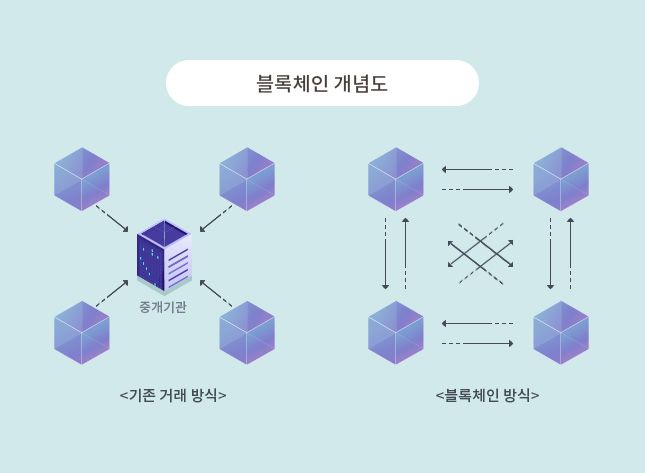
Traditional financial-transaction methods were a method where the bank holds all transaction histories. For example, if A remits ₩1 million to B, the current financial system has the bank act as an intermediary in this process—because it must ‘prove’ that A gave B ₩1 million. So the bank plays an intermediary role so the two can transact safely. Blockchain also stores and proves transaction histories. But it stores transaction histories split among many people, not a bank. If 10 people participate in one network, it creates 10 blocks of A and B's transaction history and transmits and stores them to all 10. Later, to check the transaction history, it connects the data stored split into blocks.
Features of blockchain

1. Distributed storage In traditional transaction methods, forging/altering data was possible by attacking the bank's central server. Considering the bank-network hacking incidents that occurred, this can be seen as a realistic threat. But because blockchain stores many people's data, forgery/alteration is difficult. To forge/alter a blockchain network, you'd have to attack all participants' transaction data, so hacking is considered virtually impossible. 2. No central administrator needed Unlike the existing centralized structure, it can be seen as a decentralized structure. For example, a central institution or administrator like a bank or government was needed for official proof, registration, and certification, but since many people store and prove data in blockchain, no central administrator exists. Very safe against forgery and alteration from hacking and, unlike existing methods, having the advantage that all data can be restored with just one computer even if all participants' computers disappear, this blockchain technology is also called the Fourth Industrial Revolution. Today we explored blockchain, which keeps rising. Looking at its basic concept and features, it would be good to watch with interest going forward whether blockchain will one day replace central institutions and banks, and how blockchain's high reliability and security will contribute to industry. 😁
Digital events & marketing—prepare your event with the industry's Digital Transformation leading group, Chris & Partners, specialized in it. With proven, outstanding capability, we'll create a satisfying event from planning to operation.