2022 World Water Day

2022 World Water Day
Hello, this is Chris & Partners. 🤗 Have you ever experienced a temporary water cutoff for construction or inspection? 🚿 It's fine if you've stored water in advance, but if you haven't, you've probably had an awkward experience. Water exists so naturally in everyday life that we sometimes forget its preciousness! Today, marking World Water Day, let's talk about water together. 💧
March 22, World Water Day
World Water Day, do you know when it is? 🤔 Some of you already know, and some are hearing it for the first time through this post. Every March 22 is ‘World Water Day,’ established by the UN. To prevent worsening water shortages and water pollution and to reflect on water's preciousness, the UN, accepting the recommendation of the Rio Earth Summit, adopted the ‘Resolution to Observe World Water Day’ on December 22, 1992; under it, March 22 each year was established and proclaimed ‘World Water Day,’ commemorated since 1993. Korea began commemorating World Water Day in 1995 at the UN's request to join. Each year, the UN selects a theme for World Water Day. 2020 was ‘Water and Climate Change,’ and 2021 was ‘Valuing Water.’ This year's World Water Day theme is ‘Groundwater: Making the Invisible Visible.’
World Water Forum
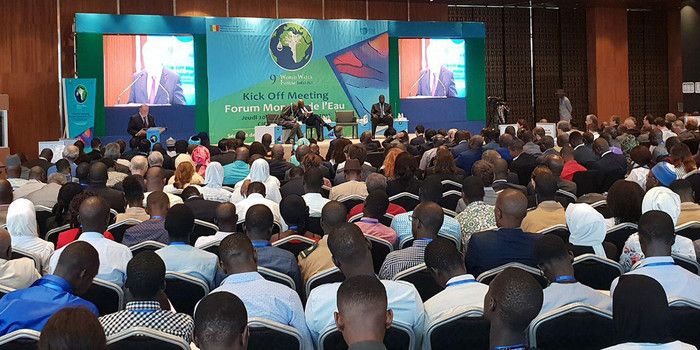
9th World Water Forum. Source: Eco Media
To draw public attention to global water issues, the World Water Council (WWC) has held the World Water Forum (WWF) for a week around World Water Day, every three years since 1997. The World Water Forum brings together governments, international organizations, specialized institutions, and civic groups from around the world to widely publicize the severity of the water-shortage crisis and promote international cooperation. It also seeks common solutions to various water issues—water-quality management, water disasters, and more. Its main proceedings include thematic, regional, and political processes, and beyond these, events such as expos take place. Korea has a history of hosting the World Water Forum too: the 7th World Water Forum was held in Daegu, Korea, in 2015. Chris & Partners has experience participating in the 8th World Water Forum Korea Pavilion held in Brazil in 2018, with exhibition-booth construction and operation. The Korea Pavilion booth represented the many institutions and companies participating from Korea in their own spaces, and within the limited space we built and ran spaces for seminars and side events. The 9th World Water Forum is held from March 21 to 26, 2022, in Dakar, the capital of Senegal.
Is Korea really a water-scarce country?
Have you heard ‘Korea is a water-scarce country’—you've probably all heard that line once, right? It's a repertoire that always comes up whenever a ‘water’-related issue arises. But although we've heard we should save water because we're a water-scarce country, in Korea, where clean, drinkable water always flows, haven't you never felt water was scarce? Is Korea really a water-scarce country? Or a water-rich one? The Population Action International (PAI) calls countries it assesses and classifies as having insufficient water ‘water-scarce countries,’ evaluating countries worldwide. Dividing rainfall runoff by population, it classifies under 1,000 m³ of available water per person as water-famine countries, 1,000–under 1,700 m³ as water-scarce countries, and 1,700 m³ or more as water-rich countries. By this institute's analysis, Korea, at 1,452 m³ of available water per person, was classified as a water-scarce country. Korea has abundant rainfall but severe seasonal variation, so the figure for lost water resources is high. Also, Korea's rainfall averages 1,300 mm a year—1.6 times the world average—but due to high population density, total rainfall per person is 2,546 m³ a year, only 1/6 of the world average. However, there is also criticism that this is meant to guard against water shortage from population growth, reflecting only land area, population density, and rainfall, and not water-supply rates, water quality, water-use efficiency, operating technology, and the like—a criticism that it's a simplistic indicator. There are also views questioning its credibility and authority in that the institute that classified Korea as water-scarce is, contrary to what's known, a private body unrelated to international organizations including the UN. Also, Korea, through continuous efforts in water-resource development and waterworks expansion, is one of the countries with very good water quality and supply. In conclusion, Korea is not a severely water-scarce country. However, it's true that we may one day lose, without warning, the water we take for granted and enjoy—due to long-term drought from abnormal climate like global warming, environmental pollution, and industrialization. As we explored together in today's post, why not take a continuous interest in water, a precious resource, and build a habit of saving it with the mindset that what we enjoy isn't a given? ☺️
Digital events & marketing—prepare your event with the industry's Digital Transformation leading group, Chris & Partners, specialized in it. With proven, outstanding capability, we'll create a satisfying event from planning to operation.